
Why Is My AC Blowing Warm Air? 7 Common Causes
Work through the seven usual causes in the order a technician would, and see which ones you can settle yourself.
- 4.9★ on Google (16 reviews)
- Open 24 hours, 7 days
- Clear, upfront quotes
By the Aero Air Techs team. Published October 30, 2026, updated October 31, 2026.
An AC blowing warm air often has a simple cause, so check the thermostat, the filter and the breaker first. You can settle all three in ten minutes with no tools. If they look fine, the trouble is usually at the outdoor unit: a dirty coil, a failed capacitor or contactor, low refrigerant or a worn compressor.
Below are the seven causes in the order a technician rules them out, with a plain line between what you can do and what calls for a service call.
Why is my AC blowing warm air? The quick sort
Match what you see to the clue column, then read that cause in the next section.
| # | Cause | The clue | Who handles it |
|---|---|---|---|
| 1 | Thermostat setting | Fan runs, nothing cools, screen blank or on the wrong mode | You |
| 2 | Clogged air filter | Weak airflow, ice on the copper lines | You |
| 3 | No power to the outdoor unit | Indoor fan runs, outdoor unit is silent | You, one breaker reset only |
| 4 | Dirty or salt-crusted condenser coil | Unit runs, cooling fades through the afternoon | You for a hose rinse, a technician for a deep clean |
| 5 | Failed capacitor or contactor | Outdoor unit hums or sits still | Technician |
| 6 | Low refrigerant from a leak | Very long run times, ice, a faint hiss | Technician |
| 7 | Worn compressor | Outdoor fan spins, no cooling, breaker trips | Technician |
One quick test helps with all of them. Let the system run for 15 minutes, then measure the air at a return grille and at a supply vent with a kitchen thermometer. A healthy system usually drops the air about 15 to 20 degrees. A much smaller drop means a real cooling problem, and that number is worth writing down.
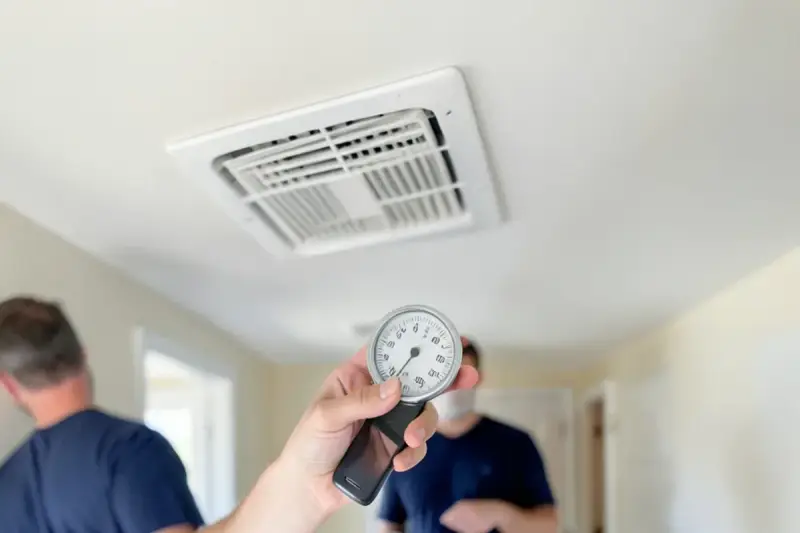
Seven causes of warm air, in the order to rule them out
1. The thermostat is asking for the wrong thing
Set it to Cool and pick a temperature a few degrees below the room. If the fan is set to On, the blower keeps moving air between cycles, and that air feels warm once it sits in attic ducts. Choose Auto. Replace the batteries if the screen is dim or blank.
2. A clogged filter is starving the coil
The indoor coil needs steady airflow to stay above freezing. Choke the air and the coil can ice over, and then almost nothing cools. Pull the filter and hold it up to a light. If you cannot see through it, replace it. ENERGY STAR puts a filter inspection on the monthly list.
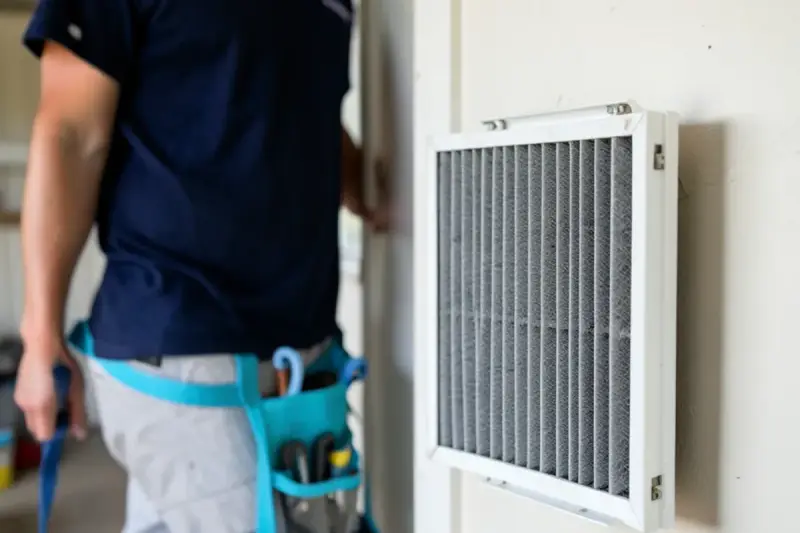
If you find ice on the copper lines, turn the system to Off, or to Fan to speed the melt, and give it a few hours before you try cooling again.
3. The outdoor unit has lost power
Your system needs both halves working. When the indoor blower runs and the outdoor unit stays quiet, you get room-temperature air at the vents. Check the breaker, and look for a shutoff lever on the wall box near the unit. Reset a tripped breaker once. If it trips again, leave it off, because a repeat trip means an electrical fault.
4. The condenser coil cannot shed heat
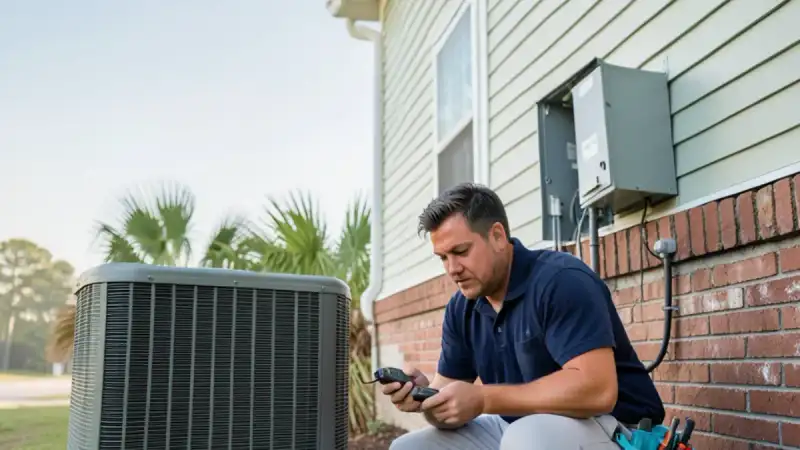
An AC moves heat outdoors through the condenser coil. Dirt, grass clippings and salt film slow that down. With the power off at the breaker, you can rinse the fins gently with a garden hose. Skip the pressure washer, since it flattens fins.
5. A capacitor or contactor has failed
The capacitor gives the fan and compressor their starting push. The contactor is the switch that sends them power. Either one can fail in the heat, and both are common repairs. Leave this to a technician, because a capacitor can hold a charge after the power is off.
6. Refrigerant has leaked out
Refrigerant does not get used up, so low refrigerant means a leak. Topping it off without finding the leak only delays the same call. EPA Section 608 requires anyone who handles refrigerant to be certified, so this one is never a homeowner job.
7. The compressor is wearing out
The compressor is the heart of the system. A failing one may hum, rattle, trip the breaker or run without moving heat. It is the costliest repair on this list, and on an older unit it is the point to weigh AC repair against replacement.
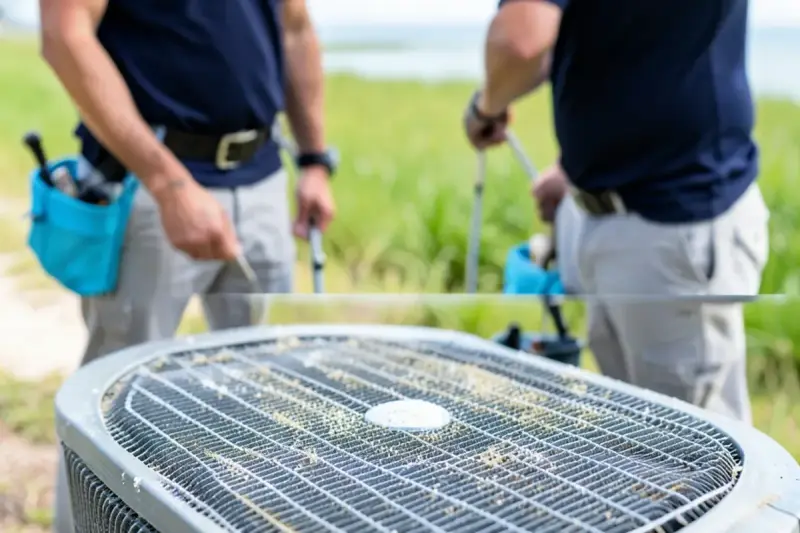
Why do James Island units get warm air calls in summer?
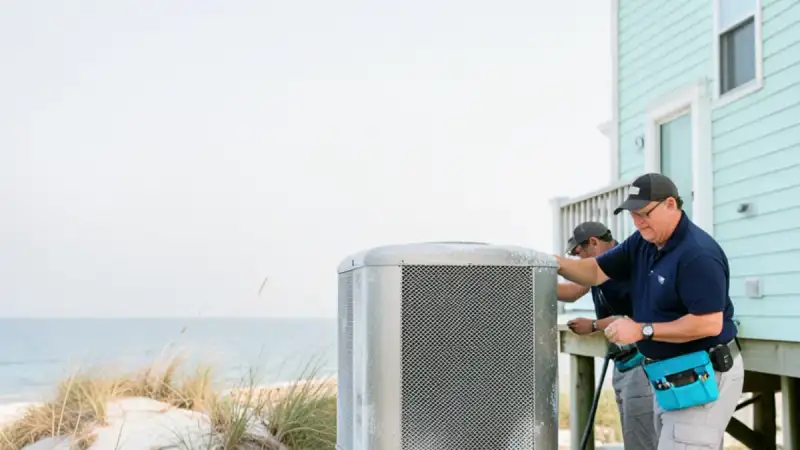
Causes 4 and 5 get extra help from the setting. On James Island, plenty of homes sit close to marsh and tidal creeks, and that means damp, salty air around the outdoor unit for much of the year.
Salt film holds moisture against the fins and speeds corrosion. Over time the coil loses its grip on heat, the system runs hotter and longer, and the electrical parts work harder. That is why a unit can seem fine in May and fall behind in July. If your coil looks crusted or the fins crumble when touched, a rinse will not bring it back. Our page on coastal corrosion AC repair explains the repair options.
When should you stop testing and shut it off?
Most warm-air problems are not dangerous, but a few signs mean you should turn the system off and wait for a technician:
- A breaker has tripped twice
- You smell burning or see scorched wiring
- The outdoor unit buzzes loudly but the fan will not spin
- Ice covers the indoor coil or the copper lines
- Water is pooling near the air handler

How do you tell which part of the system failed?
Use your ears and hands from outside the unit. With the thermostat calling for cooling, these simple checks sort most warm-air calls into one of three groups. Stay clear of the fan, and do not open any panels.
| What the outdoor unit does | What it points to | Next step |
|---|---|---|
| Fan and compressor both run, air is warm | Airflow, refrigerant or a dirty coil | Check the filter, then call |
| Fan runs, but the unit sounds thin and the top air is cool | Compressor is not pumping | Shut it off and call |
| Hums, fan does not spin | Capacitor or fan motor | Shut it off at once |
| Silent | Power, thermostat or contactor | Check the breaker once |
| Clicks repeatedly | Contactor or a control fault | Leave it off and call |
Put a hand above the fan after it has run a few minutes. A working condenser pushes out warm air, so cool air at the top means the system is not moving heat.
Why might only part of the house be warm?
That changes the list completely. If most vents blow cold and one room blows warm, the outdoor unit is probably fine. Look for these causes instead.
- A disconnected duct. A branch that fell loose in the attic is dumping cold air and leaving that room warm.
- A closed damper or register. Someone may have shut one, or a zone damper may have failed.
- A second system. In a two-system home, one unit can fail while the other carries on, and the warm floor tells you which.
- A long run in the attic. Roof heat warms the air along the way, so the last room suffers first.
Why does warm air sometimes come and go?
Intermittent faults are the hardest to catch, so record when they happen. A failing capacitor may start the unit on cool mornings and refuse in afternoon heat. A coil that freezes then thaws can cool for an hour and then stop. A float switch can cut the system and let it restart as the pan drains.
Note the time of day, the outdoor temperature and how long it lasted. Three or four entries can help a technician focus on the right part, because the system may behave perfectly during the visit.
What we tell homeowners about warm air at the vents
Note what each half of the system is doing before you call. Is the indoor fan running? Is the outdoor fan spinning? Is it blowing warm air all day or only after lunch? Those answers narrow the search more than any error code.
Do not let anyone add refrigerant without talking about where it went. Ask for the reading, ask where the leak is, and ask what the repair would involve. Any contractor should be able to answer those.
Some fixes really are small. One customer wrote that Chris "found the problem in 5 min" on an AC call. Others take longer, and a leak search takes the most patience of all. Whatever the cause turns out to be, you hear what we found, followed by a clear, upfront quote before any work. We take AC calls on James Island and nearby from our Charleston base. A spring visit for AC maintenance catches many of these problems while the weather is still mild.
Related questions
Why does my AC blow warm air only in the afternoon?
Usually the system is losing ground and has not failed outright. A dirty condenser coil, a weak capacitor or a slow refrigerant leak can hold up through a cool morning and fade when the outdoor air peaks. Note the time and the temperature drop at your vents, then pass that to the technician. The pattern narrows the search.
Why is only one room warm when the rest of the house cools?
One warm room usually points to air delivery and not the AC. A closed register, a blocked return or a kinked or split duct can starve a single room while everything else cools normally. Open the register first, then read our guide to signs of leaky ducts before you book anything.
Can I keep running the AC while it blows warm air?
Not for long. If the compressor is straining or the indoor coil has iced over, extra run time can make the damage worse and the repair bigger. Switch to Off or Fan and leave it off if a breaker has tripped twice. A few hours off also lets any ice melt, so the technician can read the system properly.
What will a warm air repair cost?
It depends on the cause, and a tripped breaker may cost you nothing at all. Parts like capacitors sit at one end of the range and compressors at the other. We quote before work begins, and our AC repair cost guide explains what moves the number in the Charleston area.