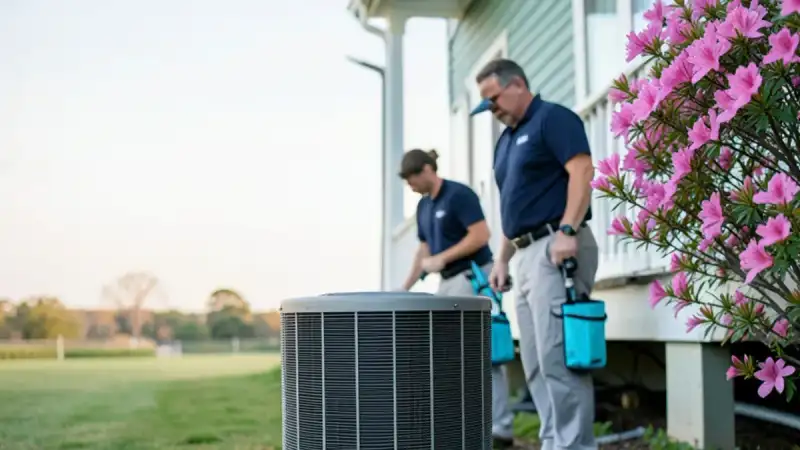
Spring AC Maintenance Checklist for Homeowners
Eight jobs you can safely do before the heat arrives, and a clear line where the homeowner part ends.
- 4.9★ on Google (16 reviews)
- Open 24 hours, 7 days
- Clear, upfront quotes
By the Aero Air Techs team. Published October 30, 2026, updated October 31, 2026.
This AC maintenance checklist covers eight jobs a homeowner can safely finish in about an hour, ideally in March or April. Change the filter, clear and rinse the outdoor unit with the power off, check the drain, test the thermostat and run the system for a few minutes.
Everything involving refrigerant, wiring or the inside of the cabinet stays with a technician.
Spring is the right time for a reason. ENERGY STAR advises checking the cooling system in spring, and NOAA normals for Charleston International Airport show 64.3 days a year at or above 90°F, with 52.1 of them from June to August. Finding a problem in April is far easier than finding it on the first hot weekend.
Your spring AC maintenance checklist
Work through these in order. Stop at any step that does not look right.
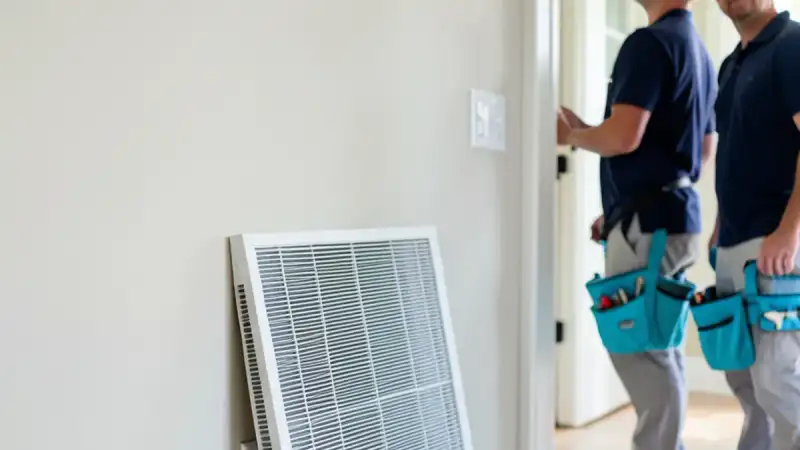
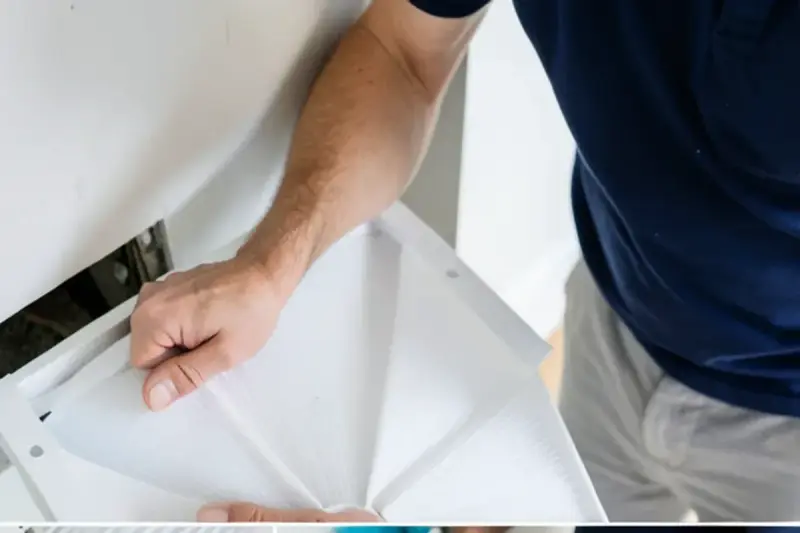
- Swap the filter. ENERGY STAR calls for a monthly look at it, so spring is only one of twelve checks. Check the arrow on the frame so it points the way the air moves.
- Clear the outdoor unit. Remove leaves, pine straw and grass clippings. Trim back shrubs so air can reach all sides, and check your manual for the required clearance.
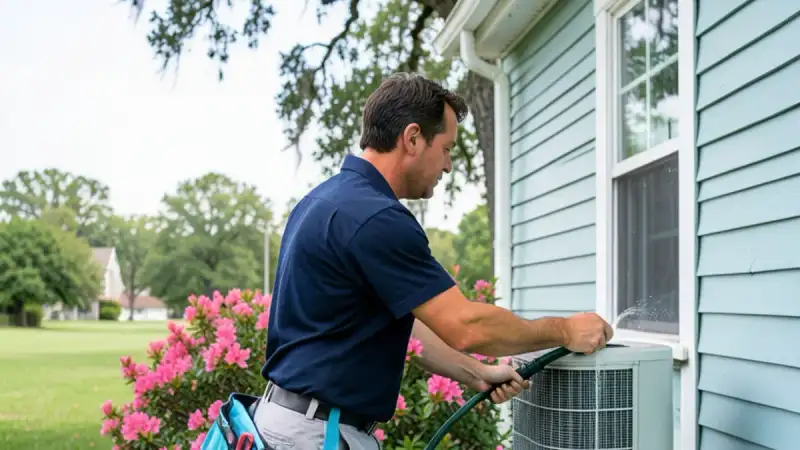
- Cut the power and rinse the coil. Turn off the breaker first, then rinse gently. The full steps are in the next section.
- Look at the pad or stand. The unit should sit level. On a raised stand, look for rust or loose hardware. Do not try to shift the unit yourself.
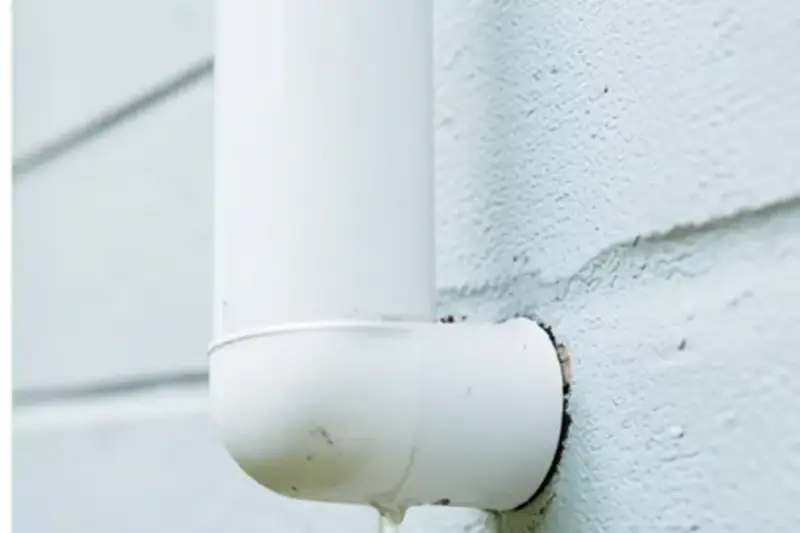
- Find the condensate drain. Know where the line ends outside, then check that it is not crushed or buried in mulch.
- Open and clear the registers. Move rugs and furniture off the supply vents and the return grille.
- Test the thermostat. Fit fresh batteries, set it to Cool and drop it a few degrees below room temperature.
- Run it and measure. After 15 minutes, compare the air at a supply vent with the air at the return. A drop of about 15 to 20 degrees is typical, and much less deserves a call.
Write the date, the filter size and any oddities on a card near the air handler. Next spring, you will have something to compare.
How do you rinse a condenser coil safely?
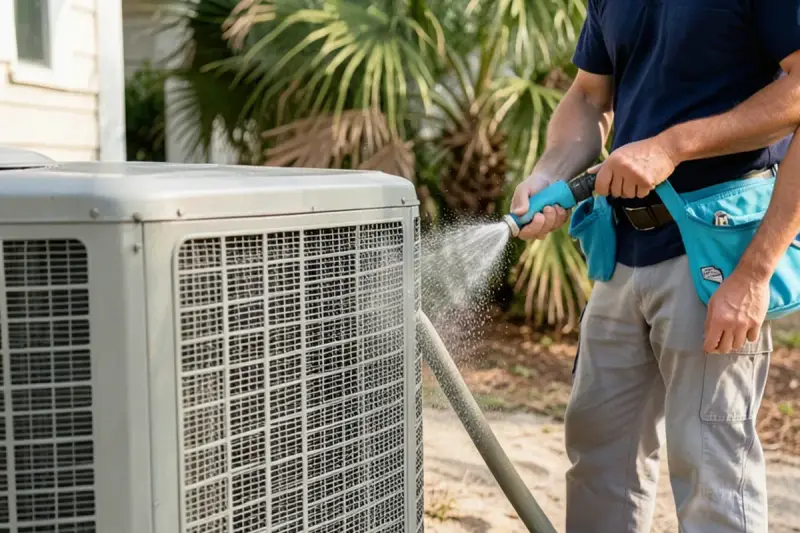
Power first, every time. The outdoor unit has a fan and live electrical parts, so never spray it while it can start.
- Switch the thermostat off.
- Turn off the breaker for the outdoor unit, plus any outside shutoff lever on its wall box. If you cannot tell which breaker it is, skip the rinse.
- Use a garden hose with a gentle spray, not a pressure washer. High pressure bends fins and pushes dirt deeper.
- Rinse from the outside of the unit, working along the fins and from the top of the coil down.
- Let it dry for a few minutes, restore power and turn the system back on.
Do not spray into the electrical box or remove the top of the unit. If the fins are flattened, crumbly or crusted white, stop there and have it looked at.
What should stay on the technician's list?
A homeowner can keep a system ready. A technician can measure how it is performing. ENERGY STAR lists most of these items as part of a contractor's annual check.
| Task | Why it is not a homeowner job |
|---|---|
| Check refrigerant level | Needs gauges and training, and refrigerant handling is federally regulated |
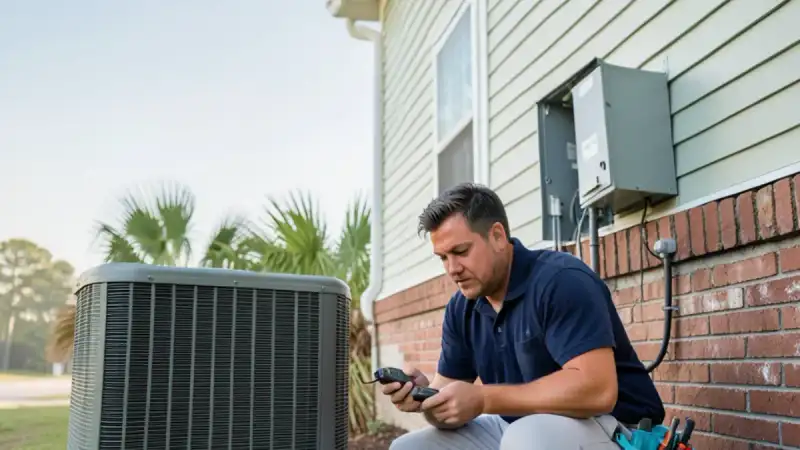
| Test the capacitor and contactor | Live voltage, and a capacitor can hold a charge after shutoff |
| Tighten electrical connections, measure voltage and current | Faulty connections can make a system unsafe |
| Clean the indoor coil | It sits inside the air handler, and access can damage panels or seals |
| Clean and adjust the blower | Requires taking the blower apart, and airflow affects efficiency |
| Check the startup sequence and controls | Takes meters and a trained eye |
| Clear a blocked drain or clean the pan | A forced clearing can crack fittings or flood a ceiling |
Book that work through AC maintenance before the season turns, and ask for a written note of what was measured.
What changes for homes in Mount Pleasant?
Mount Pleasant has plenty of larger homes with two systems and plenty of units that face salt air, so the list runs a little longer.
- Do the list twice. With two systems, each one has its own filter, drain and thermostat. Upstairs units usually work the hardest in summer, so start there.
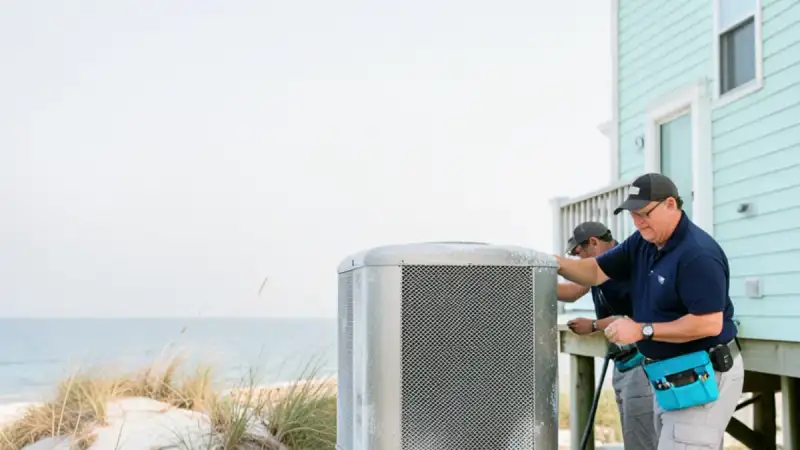
- Rinse more often. Near the water, a yearly rinse may not be enough. Look at the fins every few months and rinse when you see a film.
- Check the attic air handler pan. If yours sits in an attic, look from a safe spot for rust or standing water in the secondary pan.
- Watch for white powder or flaking. That usually means the coil is corroding. Our page on coastal corrosion AC repair covers what can be done.
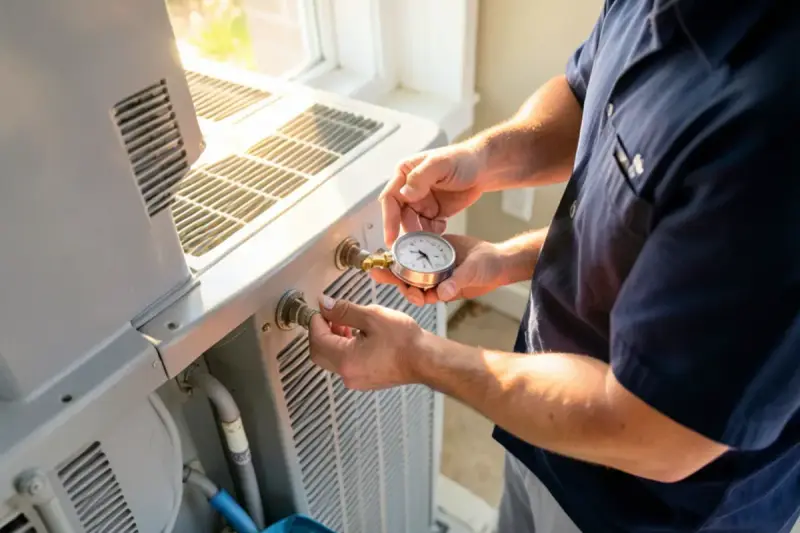
What should the temperature drop tell you?
Step 8 gives you a useful number. Trade rules of thumb look for roughly 15 to 20°F between the return and a nearby supply vent, once the system has run for 15 minutes on a warm day. Treat that as a rough guide and not a pass or fail.
| What you measure | What it may mean | What to do |
|---|---|---|
| About 15 to 20°F drop | System is cooling normally | Note the number for next year |
| Under about 12°F | Low airflow, low charge or a dirty coil | Check the filter, then call |
| Above about 22°F | Restricted airflow | Check the filter and registers first |
| Same reading all rooms | Normal on a healthy duct system | Nothing |
| One room far warmer | Duct leak or blocked run | Look at that branch |
Humidity changes these numbers, so a very sticky day can show a smaller drop on a healthy system. Write the date, the reading and the outdoor temperature on a card by the thermostat. Next spring, the comparison will tell you more than either number alone.
How do you clear the drain before it clogs?
Find the line first, since many homes have a white PVC pipe near the air handler with a capped tee. If you see a cleanout, this takes five minutes.
- Turn the system off. Do this at the thermostat before opening anything.
- Remove the cap. Look for standing water or slime in the opening.
- Pour in a cup of distilled white vinegar. Some manufacturers say otherwise, so check your manual before you add anything.
- Wait 30 minutes, then flush with water. Watch that it runs out at the outside end.
- Replace the cap and restart. Check the pan after an hour of running.
If water backs up, or the line runs only as a slow drip, a wet vacuum at the outside end can pull the clog. A line that clogs every year may need a better slope or a cleanout added, and a technician can tell you which.
What should you book before May?
Book the visit you can't do yourself, and do it before the first long hot week. Breakdowns pile up from May through September, and a calmer month gives you more choice of dates. Ask for the capacitor reading, the contactor condition and the drain check in writing, so next year's visit has something to compare against.
When does a checklist item become a service call?
Most items pass. These results mean it is time to stop and call.
- The breaker trips when you restore power
- The outdoor fan does not spin, or the unit hums without starting
- The air drop at the vents is well under 15 degrees
- Ice forms on the copper lines
- You find water in the secondary pan or on the ceiling
- You hear grinding, squealing or loud buzzing
- The air smells musty or burnt when the system starts
If the vents are blowing warm air, our guide to why an AC blows warm air sorts the likely causes.
Our advice for a calm first hot week
Do the list on a mild day, not the first 90-degree one. If something is wrong in April, you can compare options, ask questions and plan the work around your week.
Write down what you find. A note that says the upstairs vents dropped 12 degrees in April gives a technician a head start, and it shows a trend from year to year.
Do not skip the rinse because the unit looks clean. Salt film is hard to see. Do not go past the panels because a video made it look easy. Live voltage does not care how careful you are.
Our base is in Charleston and Mount Pleasant is within the area we serve. If your check turns up a problem, you can call for AC repair and get a clear, upfront quote before work starts.
Related questions
When should I run through this checklist?
March or April suits the Charleston area. It leaves time to book any repair before the heat arrives, and NOAA normals show most of the airport's 90-degree days land in June through August. Run the system on a mild afternoon, when a problem is an inconvenience and not an emergency.
Do I still need a technician if I do all this?
ENERGY STAR lists a contractor check as a yearly item, and it covers things this checklist cannot, such as electrical connections, refrigerant level and blower cleaning. Your list keeps the system ready. A tune-up finds the problems you cannot see. Near the harbor, where salt air works on the coil, that inspection matters even more.
Can I pour something down the drain line to keep it clear?
Check your owner's manual first, since advice varies by system. The safe homeowner job is to confirm the line drips outside when the AC runs and to report any standing water in the pan. Do not push wire or force air through the line. A clogged drain is a short service call, and it beats a soaked ceiling.